$1.2 Million Keck Foundation Bridge Funding Initiative Makes Awards to Early‑Career Scientists at UC Davis
By Neelanjana Gautam
The University of California, Davis, is pleased to announce new awards totaling $1.2 million from the Bridge Funding Initiative supported by the W. M. Keck Foundation. This investment will provide critical resources to six high‑impact basic science projects during a period when early‑stage research often faces significant funding uncertainty. The initiative will enable faculty researchers and graduate students to maintain continuity in their work across science, engineering and medicine.
“This one-time grant program by the Keck Foundation represents an important commitment to supporting and retaining early-career faculty and graduate researchers, strengthening their ability to advance innovative scientific discovery,” said Simon Atkinson, vice chancellor for research at UC Davis. “It also underscores our shared commitment to fostering innovation and supporting the next generation of scientific leaders.”
Last year, the Office of Research issued a campus-wide call for proposals from faculty–graduate student pairs, resulting in nine submissions. An internal review committee evaluated each application in alignment with the priorities outlined in the Bridge Funding Initiative guidelines. Associate Vice Chancellor for Research Cristina Davis evaluated the review committee’s recommendations out of which six projects were nominated for funding. The selected teams will use the funding to support ongoing experiments, acquire essential research materials, and maintain personnel continuity — elements that enable early‑stage projects to thrive and progress toward future external funding and long‑term success.
“We are grateful for the Keck Foundation’s support for the exciting and important research efforts of our early career researchers — both faculty and students,” said Davis. “The breadth of these projects is astonishing — from attacking the tiniest viruses to exploring the universe.”
Recipients of the bridge funding grant program
Understanding the impact of the gut microbiome on skeletal health
One of the projects, The Role of the Aging Microbiome in Stem Cell-based Bone-Gut Crosstalk, is led by Thomas H. Ambrosi, assistant professor in the Department of Orthopaedic Surgery, in collaboration with graduate student Kelly C. Weldon. They are exploring how age‑related changes in the gut microbiome drive deterioration of the skeletal stem cell-derived microenvironment and how this contributes to osteoporosis, osteoarthritis, and other degenerative musculoskeletal conditions. The funding will enable researchers to pursue an interdisciplinary approach integrating immunology, microbiology, stem cell biology and metabolomics to reveal how gut‑derived signals regulate skeletal health during aging that could reveal clinically relevant insights.
Does inflammation drive the mitochondrial failure and DNA damage at the root of ataxia?
Many ataxias (a neurological condition affecting movement) show a mix of DNA damage, inflammation, and mitochondrial dysfunction, but it remains unclear which of these problems comes first and which are downstream consequences. Because damaged mitochondria can trigger inflammation, and inflammation can in turn damage mitochondria and DNA, these conditions may form a self‑reinforcing cycle that obscures the true molecular cause of disease. This project led by Jacqueline Barlow, associate professor Microbiology and Molecular Genetics, along with graduate student Judith Fishburn in Integrative Genetics and Genomics tackles the fundamental question of what actually starts the disease process by testing a novel hypothesis: that increased inflammation may be the upstream catalyst that causes both mitochondrial defects and elevated nuclear DNA damage in ataxia.
Multi‑agent AI architecture aims to deliver traceable, constraint‑aware reasoning for safety‑critical decisions
Modern AI systems excel at producing fluent answers but struggle with reasoning, often failing to detect when their outputs violate fundamental constraints—an issue that makes them unreliable in safety‑critical domains such as disaster response, medical triage, and spacecraft operations. Led by Rich Whittle, assistant professor in the Department of Mechanical and Aerospace Engineering, with graduate student Kaisheng Li, the project will investigate how multi‑agent architectures can achieve transparent, auditable decision-making under uncertainty through distributed, role‑based reasoning.
The team is building an AI guidance system modeled on real emergency-operations teams, where specialized agents handle information lookup, simulation, and decision explanation. This allows complex procedures to be broken down into coordinated, constraint‑aware steps that can clearly justify each decision.
Molecular determinants governing evolutionary plasticity of flavivirus-host protein interactions
Viruses rely on close virus‑host protein interactions to replicate. Similar viral proteins often have similar interactions. Sometimes this relationship breaks down and viral proteins with large differences still have very similar interactions. Led by Priya Shah, associate professor chemical engineering in the Department of Microbiology & Molecular Genetics, along with graduate student Chase L. S. Skawinski, the project aims to understand how certain related viruses—yellow fever virus, Zika virus, West Nile virus, and dengue virus—evolve their protein interactions in seemingly counterintuitive ways.
To do this, the team will study two different types of viral proteins, those that are highly similar across the different viruses, and those that are very different. They will see which human proteins these viral proteins attach to. They’ll use advanced tools to filter out background noise so they can focus on the most important connections. They’ll then look for patterns to identify whether specific parts of the viral proteins allow them to maintain protein interactions.
By the end of the project, the researchers hope to learn how viruses evolve new protein interactions. Their findings could point to new treatment strategies for virus infections that currently have no approved therapies.
Biofilms as active architects: Engineering microbial communities to steer subsurface fluid flow and transform transport in complex porous media
Microbial biofilms can dramatically reshape how fluids move through soils and rocks, but we still lack a fundamental understanding of how they alter flow, transport and reactions in the subsurface. The project team led by Verónica L Morales, associate professor in the Department of Civil & Environmental Engineering, and graduate student Hamidreza Khoshtarash aim to uncover those rules and use them to intentionally steer fluid movement by directing biofilm growth into high‑permeability pathways. Through a combination of microfluidic experiments, advanced imaging, and numerical simulations, the team will study how pore‑scale structure, microbial traits, and dynamic clogging cycles interact to reroute flow and redistribute fluid phases. The resulting framework for targeted biofilm‑flow steering will position microbes not as passive inhabitants but as active tools for controlling subsurface processes, with potential applications in groundwater cleanup, energy storage, and carbon management.
Polymer‑engineered electrodes unlock a new pathway for converting captured CO₂ into cement‑ready oxalate materials
Another funded project led by Jesús M. Velázquez, associate professor of chemistry, and graduate student Richard Gómez Caballero is exploring a creative new way to turn captured carbon dioxide (CO₂) into a solid material that can be used to make cement. This approach could help reduce carbon emissions by actively utilizing CO₂ as a feedstock to create a valuable building product.
Instead of using traditional methods that rely on harmful heavy metals, the research team is developing special coated electrodes that need only tiny, trace amounts of metal to work. These coatings help guide CO₂ through a chemical process that turns it into a solid called oxalate.
The team will test different types of protective films to see how they affect the reaction and how well they help convert CO₂ into a material that can be easily collected and used. By understanding how these films influence the process, the researchers hope to create a practical, scalable way to produce oxalate that can go straight into cement manufacturing.
In the long run, this work aims to show that CO₂ can be captured and transformed into a valuable ingredient for next‑generation, more sustainable cement—offering a novel solution for both the environment and the construction industry.
About the W. M. Keck Foundation
The W. M. Keck Foundation was established in 1954 in Los Angeles by William Myron Keck, founder of The Superior Oil Company. One of the nation’s largest philanthropic organizations, the W. M. Keck Foundation supports outstanding science, engineering and medical research. The Foundation also supports undergraduate education and maintains a program within Southern California to support arts and culture, education, health and community service projects.
Feature Image Caption
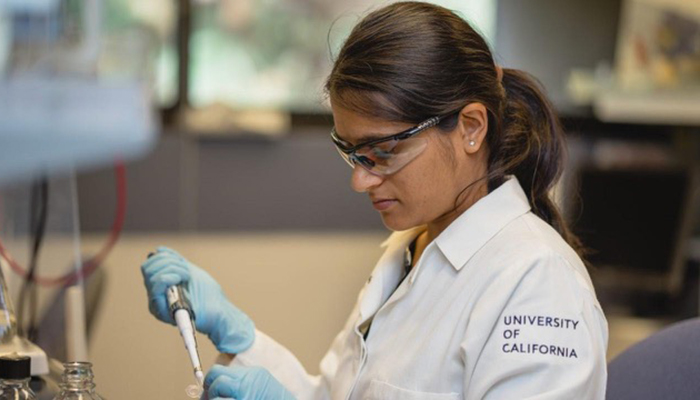
Priya Shah, associate professor chemical engineering in the Department of Microbiology & Molecular Genetics, is leading a project which aims to understand how certain related viruses—yellow fever virus, Zika virus, West Nile virus, and dengue virus—evolve their protein interactions in seemingly counterintuitive ways.