
Research Core Facilities Survey
Survey to assess research core facility use and needs at UC Davis. 2023. Haczku A, Girard I, Henderson S, the UC Davis AVC Research Core Workgroup and the SOMOR Evaluation Unit, UC Davis.
Background
The Research Core Facilities Program was developed in response to the 2014 UC Davis Core Research Facilities and Resources Committee Report. Although the RCFP delivered on several important goals, there is increasing recognition that a sustainable and strategic plan for investment in core facilities has not emerged. In September 2022, Associate Vice Chancellor for Interdisciplinary Research and Strategic Initiatives (IR&SI) Cristina Davis charged an AVC Cores Working Group to provide a roadmap (principles & operation) to guide total campus investment over 5- and 10-year timelines in cores that support critical research.
As part of the effort to understand the campus core landscape and researcher needs, the AVC Cores Working group developed and launched an anonymous survey for the UC Davis research community, including faculty, trainees, staff, students, clinicians and researchers. The survey was designed to solicit researcher input on current and recent use of cores and shared facilities, including challenges, unmet needs, concerns and comments.
Results
Response and users. The survey was widely distributed through email lists in early Dec 2022 with a communicated deadline of Dec 9. Response rate was highest on Dec 5 (n = 105) and Dec 6 (n = 296). Of the 648 retained cases, 546 were completions and 102 were non-completions. The median time to completion was 268 seconds. Almost 61% of respondents indicated they were current or recent users of cores (n = 394), with 143 negative responses and 88 responses of “unsure” to Q8. Do you currently use or have you recently used UC Davis research cores?
School. Respondents identified with a range of schools and colleges. Response was highest in College of Letters and Science (n = 122), College of Engineering (n = 118) and School of Medicine (n = 102). Seven responses were from external institutions and 37 were blank and could not be identified: these were not included.
Position & PI. Approximately 50% of respondents identified as assistant or associate professors, or professors. The remaining respondents were largely staff or students. Of the
42 respondents who selected “other,” 11 identified as postdoctoral researchers and 15 identified as project scientists or researchers. About 45% of respondents (n = 297) indicated that they are currently a PI on a sponsored grant.
Funding source and agency. Of the 297 responses for funding, the majority indicated a federal funding source (n = 269). About 44% of respondents indicated only federal funding as a source (n = 132) with the remaining respondents indicating a mix of federal, foundation, industry and other funding. A total of 90 respondents included foundation funding and 73 indicated industry funding. NIH was indicated as the funding agency for a large portion of respondents (n = 161), followed by NSF (n = 93) and other agencies (n = 103). A smaller number of respondents indicated funding from the Centers for Disease Control (n = 7), Department of Defense (n = 28), and Department of Energy (n = 32). Of those indicating “Other,” 23 respondents provided USDA as the funding agency.
Importance and meeting needs. Of all respondents who ranked the importance of cores to the success of their research (n = 364), the largest portion selected the highest rank (n = 279): 77% of respondents for this question ranked cores as essential (rank 10). Of respondents who ranked how well UC Davis cores meet their needs (n = 358), about 33% (n = 117) indicated that cores fully satisfy their needs.


Barriers. The most common response to main limitations and barriers to use (Q14) was “Lack of information about available core resources and how to access them.” The least common response was “Inconsistent or poor quality of contracted work.” Responses were distributed among the other options, including almost 10% of respondents indicating that no limitations or barrier to use were identified. Of the 75 free-text responses provided for “other,” two themes emerged: 17 responses were similar to “I don’t know what cores are,” and 10 responses were similar to “Cores are too short-staffed.” Remaining responses were uncategorized.
Cores most valuable. A total of 688 responses were recorded for 3 UC Davis cores most valuable for your research needs (Q9). The responses were coded to 92 separate entities or themes, with 54 cores or shared facilities mentioned in one or two entries each. Ten cores or facility types received at least 3% of compiled responses (n > 20 mentions). Note that general responses listing mass spectrometry, microscopy, and imaging (which are available in a number of cores and shared facilities), were grouped as a general type.
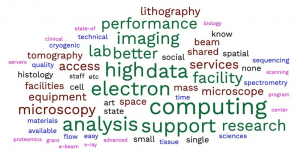
Cores currently not available. Full-text answers (n = 147) were varied in response to Q15. Please list in order of importance up to 3 core services that would be valuable for your research needs but are currently not available at UC Davis. Responses were categorized by theme, with computing, microscopy, and statistical analyses emerging as valued resources and expressed as a word cloud.
Impactful investments. The most common responses regarding impactful campus investments were to subsidize core fees and to provide additional salary support (table below). Of the 42 free-text responses added for “other,” 10 were similar to “I don’t know what the cores or core needs are.”
| Impactful investments | n | Percent |
| Subsidize core fees to lower user rates | 249 | 19.39% |
| Additional salary support to hire more core staff | 244 | 19.00% |
| Additional funds for the acquisition of new instrumentation or shared resources | 220 | 17.13% |
| Expand and subsidize training opportunities for researchers | 146 | 11.37% |
| Service contract support for the repair and upgrade of existing […] resources | 142 | 11.06% |
| Increase the marketing and communication around core services | 90 | 7.01% |
| Invest in establishing new cores | 86 | 6.70% |
| Sunsetting outdated or redundant cores | 65 | 5.06% |
| Other | 42 | 3.27% |
External service. About 37% of respondents indicated that they currently use an external service provider for services, equipment, and/or consultation (Q17). The most common reasons cited for using an external provider (Q18) were lower cost and limited services at UC Davis.
Additional information. Additional information was shared by 117 respondents. Of the 111 informative responses, the most common topic (31%) was support and investment in cores, staffing or equipment (n = 34). Other common topics were computing/HPC (n = 10) and visibility of core resources (n = 11). A majority of comments related to specific cores, services, or needs.
Methods
The Research Core and Shared Facility Survey was developed with input from the AVC Cores Working Group members with leadership from Angela Haczku (SOM Office of Research) and guidance from Stuart Henderson (Director, SOM Office of Research Evaluation). The survey was implemented in Qualtrics and launched on Nov 22, 2022. The survey was distributed through email, including through the AVC Cores Working Group, to the Associate Deans for Research (Dec 1), and the Core Facilities listserve (Dec 5). The deadline included in communications was Dec 9, 2022. One reminder was sent to the groups above on Dec 5 – 8. The survey remained open until Jan 3, 2023.
The survey was closed at 9:00 am (PST) on Jan 3, 2023, and the data were exported from Qualtrics into Excel for summary and visualization. A total of 855 responses were received, of which 648 responses were retained for analysis. Forty-four cases of duplicative responses were identified with submissions of 2 – 14 responses per IP address. Responses were considered duplicative if responses originated from the same IP address, with similar submission times and highly similar information. The most complete response from the duplicative set was retained. Responses with a duration less than 60 seconds and without completion were removed, as these appeared to be exploratory examinations of the survey.
The 648 retained cases were analyzed in Excel and JMP (v.17).
School or college was offered as an open-text response (Q2. Your school.). Although the intent was to capture school or college (e.g. School of Medicine), many respondents provided a version of “UC Davis.” Where possible, this general response was coded to school or college based on the free-text answer to Q3. Your department.
Responses were compiled without regard to rank (1, 2, 3) for Q9. Please list in order of importance up to 3 UC Davis cores most valuable for your research needs. Cores were coded to identifiable cores or shared resource facilities where possible. Generic responses with low confidence matching to a known or specific entity were grouped in themes like “microscopy” or “mass spectrometry.” Responses with the same answer in all three rankings were recorded only once.
Responses were compiled without regard to rank (1, 2, 3) for Q15. Please list in order of importance up to 3 core services that would be valuable for your research needs but are currently not available at UC Davis. Answers identifiable to known cores (e.g. Campus Mass Spectrometry Facility) were omitted from analyses of cores not currently available. Responses with the same answer in all three rankings were recorded only once. Responses were grouped into non-discrete themes with many answers uncategorized.
Responses were compiled for Q19. Please share any additional information on your experiences or suggestions on how to improve UC Davis cores/services. Non-informative answers such as “none” or “N/A” were removed from the summary analysis. Comments identifying a specific core or person were removed at the authors’ discretion and replaced by […]. Comments were annotated with a topic or core to group similar themes. Comment ID was added as a reference only and was not related to survey input.
NOTE: If you would like to request materials from this survey, please contact us at [email protected]. Our team will assist you in accessing the information you need.
Connect With Us
We are committed to ensuring accessibility of our website content. If you have difficulty accessing any material on this site, please contact us at [email protected] so we can assist you.
